Tuesday, March 4, 2014

Living in Japan 7 Month Survey

Well we have been here for just over 7 months now and we thought it would be good for you (and for us) to see how we are doing with things in Japan. Some of these are silly some are more important. We came up with a short survey of our experiences here and we will both tell about the same things, I will share now and Clint will put his up in another post.


Favorite drink: Royal Milk Tea


Best food eaten so far: Yoma’s
            I have started going toing to a bi monthly dinner hosted by an older Japanese man named Yoma. He started by cooking dinner for his friends and band members many years ago and he has branched out to inviting English teachers in the area as well. There are between 5 and 15 people at any given dinner. We all gather in his house to eat and chat. He makes delicious traditional Japanese food that includes no less than 6 components and often many more.


Best dessert: baumkuchen
            Originally from Germany it is a very popular Japanese dessert. It tastes similar to a crepe cake, slightly eggy and slightly sweet. It is usually topped with a syrup of some kind and the hole is filled with whipped cream. So tasty!!


Worst food eaten so far: tako yaki
            Octopus balls are a common street food that is often made at home also. They are fun to watch being cooked in giant trays. Though octopus isn’t my favorite I don’t mind it in pickles or in sushi occasionally. My issue with them is a texture one. When tako yaki are cooked they get brown on the outside but remain “creamy” in the middle, this results in a semisoft ball filled with chewy octopus pieces. Think undercooked pancakes ball with an edible rubber band in the middle. Some people love it, I do not!


Favorite place to visit: Tokushima Castle Park
            Tokushima’s Central Park is situated on old castle ruins and has great walking paths with ponds and rose gardens. It also has a big hill where you get a great view of the city.

Favorite activity: eating
          This shouldn’t surprise anyone, My favorite regularly done activity is eating lots of different foods. Japan has an amazing cuisine and I can’t get enough of it.


Biggest daily frustration: Where does this trash go?
            I did a whole post on trash but this is a daily frustration. Every piece of trash needs to be discarded thoughtfully, which is great for the environment but makes throwing things away very difficult. Particularly storing the trash in the kitchen, we need five trash cans and extra space for things that only get picked up once a month. Grrr

Small thing that makes you happy: reading a sign in less than a minute
            Learning Japanese is hard, I’m getting better… slowly.

Most thankful for: Technology
            Having a smart phone has been a lifesaver.  It makes talking to family and friends easy, it also makes getting around the city, catching the bus, translating signs and packages, and keeping track of my schedule much easier.

Hardest thing to do: get anything fixed
            Language barriers as well as cultural barriers make this soooo difficult.

Something you wish you would have done before coming: gotten a driver’s license
            Not romantic, but perfunctory.

Best experience so far: playing on the beach at the river
            I think we also posted about this experience here. It was an amazing day with good people and awesome scenery


Item most missed: bike
            I really miss my wonderful single speed glow in the dark bike. I have a bike now it works to get me from place to place but I have to peddle like I’m riding a clown bike, it’s silly.

Food most missed: Mexican and margaritas on the patio
            This is self-explanatory, these things don’t exist in our area.

Most surprising/shocking discovery: The separation of outdoor versus indoor spaces, except for air.
             I may have to do a separate post on this because it is fascinating and not something I completely understand yet.

Goal for the next six months: practice Japanese in order to be more involved in the community


If there are things you are wondering about that we didn't cover please let us know. We can answer any question yo have.


Thursday, February 6, 2014

The New Year

This should have gone up a while ago. Oops!

The New Year celebration in Japan is different than New Year in the States. Here, I feel like there is a greater importance placed on the changing of the year and the symbolism of “new” year.  There are multiple ways the changing from one year to the next is commemorated here. I will try to give a succinct description of some of them , but honestly you could write a whole book delving into the specifics.


Food
New Years day food preparations take hours and hours of work to put together and include a specially prepared group bento called a “Osechi”. It contains herring roe, dried Japanese anchovies, sweetened black soybeans, crushed burdock root, sweet pure of chestnuts and sweet potato, shrimp, and steamed fish paste.  Each has a specific reason for being in the meal and has importance. Alongside the osechi sushi or sashimi is served and also rice cake (mochi) soup that is made differently depending on the region.


Bells
At midnight on December 31, Buddhist temples all over Japan ring their bells a total of 108 times to symbolize the 108 human sins in Buddhist belief, and to get rid of the 108 worldly desires regarding sense and feeling in every Japanese citizen.


First
The new Year brings the first time something will happen in the particular year, many of these thing are celebrated. An example of this is the first sunrise of the year. Before sunrise on January 1, people often drive to the coast or climb a mountain so that they can see the first sunrise of the New Year. Here in Tokushima people watched it over the Yoshino River or on top of Mt. Bizan
Hatsumōde is the first trip to a shrine or temple. Many people visit a shrine after midnight on December 31 (when they bells can be heard) or sometime during the day on January 1. People pray for their safety and for peace in the New Year.

Mochi
I mentioned the making of Mochi in a previous post but didn’t quite realize its significance at the time. During the New Year celebration mochi is not only eaten in the New Year meal but also used in decorations and hold symbolic meaning. The mocha is stacked and places with pine fronds and oranges on a pedestal as an offering for prosperity and longevity.


Postcards
New Year post cards are sent out similarly to Christmas cards in the states. They often have pictures of the New Year’s zodiac animal on them or a family picture.  This  year’s animal is the horse so we got a few postcards with horses on them wishing us luck in the new year. They post cards are often written one by one and in calligraphy.


Otoshidame
A gift of money is given to children in special paper envelopes on New Year’s Day. Every child in a family receives the same amount of money, usually around $100 dollars

We celebrated New Year ’s Eve by going down to the Shinmachi arcade by the river. We saw live music, ramen eating contest and lively hosts. We ate some roasted sweet potatoes and walked down the boardwalk where there were vendors sell street food and local goods. They handed out helium balloons and projected a live countdown on a large screen. At the stroke of midnight we let the balloons into the air and streamers shot into the sky alongside fireworks. We rode out bike home shortly afterward and could hear the bells ringing from the nearby temples.


Setsubun


Monday was Setsubun in Japan and while it’s not a National Holiday it is still something that is celebrated. It is celebrated on February 3 or 4  which is the first day of spring on the Japanese lunar calendar. The holiday is to purify the home and ring in the new spring season. This is done by warding off the bad spirits and welcoming in the luck.

According to Japan Guide “Some families put up small decorations of sardine heads and holly leaves (柊鰯 hiragi iwashi) on their house entrances so that bad spirits will not enter.”  The smell is said to ward of the demons. I haven’t seen any of these decorations and I’m happier to say I haven’t smelled them either. 


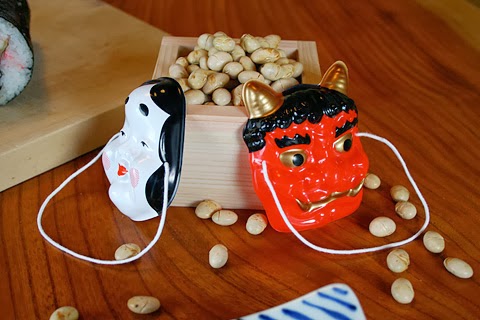
Another way of warding off demons is to throw beans at them. The head of the household (or classroom in our case) dresses up in an “Oni” mask and beats a drum, surprising and frightening the children.


After the children recover from their initial scare they are supposed to throw fortune beans (roasted soybeans) at him and scream “Demons out! Luck in!" (鬼は外! 福は内! Oni wa soto! Fuku wa uchi!


This is done at home, at school, and at temples. The beans are thought to symbolically purify the home by driving away the evil spirits that bring misfortune and bad health with them.
In order to bring luck back in, people (usually children) pick up the beans and eat them. One bean is eaten for every year the person has been alive and sometimes one more for the upcoming year.

Initially this was supposed to happen on a day I would not be at work but as luck would have it I got to witness this event with a class that celebrated a day late. The kids all made Oni masks pretending to scare each other, then the "real" Oni came in and frightened them all to death. 


The event while symbolic was also a chance to scare the crap out of the kids while adults laughed at them and took pictures. Some kids cried so hard and for so long they didn't get a chance to throw anything at the demon. Does this mean a year of bad luck?

The demon is also used as a bargaining chip, similar to the way Santa is around Christmas, only in reverse. For a few weeks before the event children were warned “Oh, you better be good or Oni will come” and after the event the same thing but with more frightened responses from the children. “Oni will come back if you are not good”  


Aside from frightening children and hanging fish heads near your door, other celebrations of Setsubun involve eating Nori Maki. Nori Maki is a special 20cm sushi roll that is eaten in it entirely rather than being sliced. In some areas, the Nori Maki is made with a stuffing of seven colors which represent Shichi Fukujin (seven gods of happiness).  


The roll is eaten in silence while facing the “lucky direction” of the year. Those who can eat the whole thing without saying a word are promised luck with their business, longevity, and freedom from illness.


Clint and I didn’t attempt to eat the Nori Maki though we did see them at the store and they looked quite tasty. We were attending a Super Bowl viewing party and had pizza and other treats awaiting us. In hindsight maybe we should have stuck with the sushi and the hope of better luck for the Broncos.


Better Luck next year Broncos!!

Monday, January 6, 2014

Mochitsuki


Traditionally Mochi is made from a labor intensive process that involves pounding rice into a gluttonous mass using wooden mallets. It is usually done on the 25th of December and used in the New Year celebration. I was lucky enough to be part of mochitsuki at school this week.


We started with rice that had soaked overnight and was then steamed until cooked. The already quite sticky rice was placed in a big stone bowl called an uzu. 

The rice was smushed until it stuck together, then we then took turns hitting it with large wooden mallets called kine. At first I just watched but then was beckoned over to help with the manual labor.


Three of the four people had mallets and would hit the rice in sequence either calling out a number or repeating a chant. The third person would either wet the mochi or turn it. If the mocha isn’t wet the mallets will stick to it and things will get very messy very quickly.All the kids got a turn hitting the rice and the loved it!!


When the rice was pounded into one sticky mass it was moved to a large turn crank funnel. It squeezed the mochi into a tube which was cut into small balls and rolled in potato starch. This was a VERY sticky process. Once the balls were rolled int stach they were much easier to handle.


Some of the balls were filled with anko (bean paste) or kinako (soy flour and sugar) and some were left plain. 


Mine had kinoko and was delicious. Mochi had a very subtle taste like slightly sweetened rice the addition of the kinoko gave it a sweet and nutty taste but also changed the texture. Mochi alone it very sticky and gummy, but the powdered kinako added a bit of crunch and dryness.

 All the kids loved making the mocha and loved eating it even more.

Tuesday, December 31, 2013

Fall in Japan


O Autumn, laden with fruit, and stain’d
With the blood of the grape, pass not, but sit
Beneath my shady roof; there thou may’st rest,
And tune thy jolly voice to my fresh pipe,
And all the daughters of the year shall dance!
Sing now the lusty song of fruits and flowers.

The narrow bud opens her beauties to
The sun, and love runs in her thrilling veins;
Blossoms hang round the brows of Morning, and
Flourish down the bright cheek of modest Eve,
Till clust’ring Summer breaks forth into singing,
And feather’d clouds strew flowers round her head.

The spirits of the air live in the smells
Of fruit; and Joy, with pinions light, roves round
The gardens, or sits singing in the trees.
Thus sang the jolly Autumn as he sat,
Then rose, girded himself, and o’er the bleak
Hills fled from our sight; but left his golden load.

-To Autumn, William Blake, 1783

The colors, children!!!

-Professor John Frink, 1995

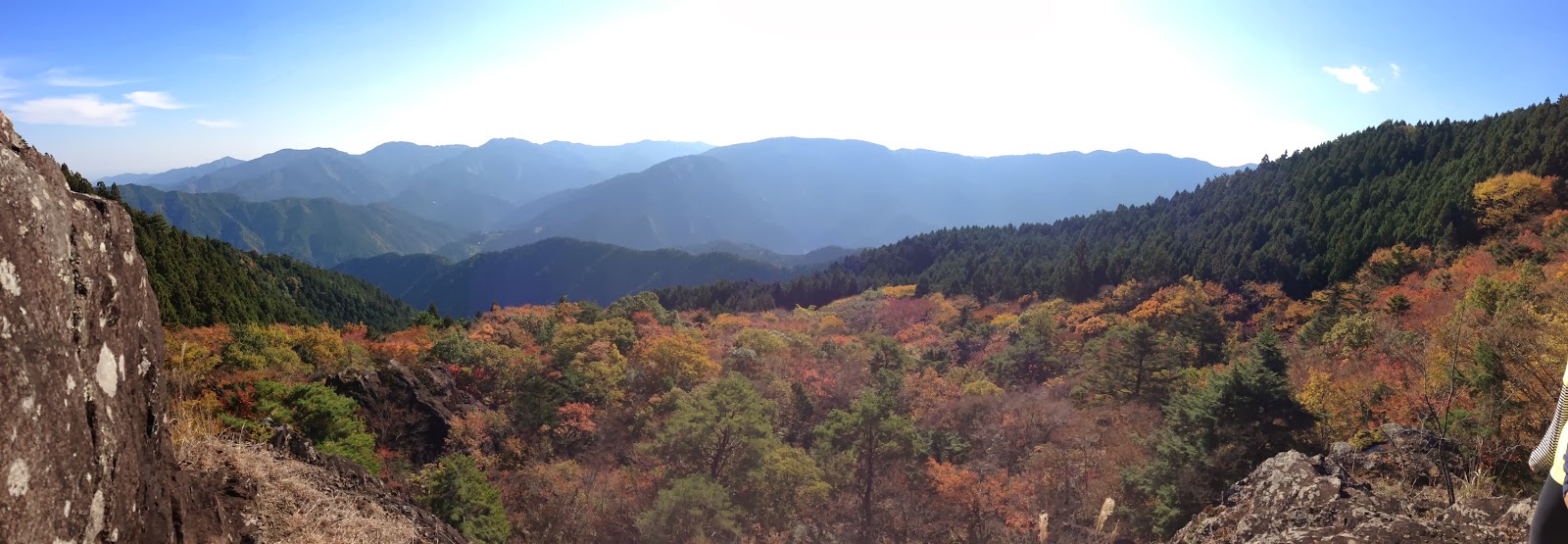
Back in November, I went out to Kamikatsu on a guided hike to see some of the fall colors. The fall colors here (kouyou or momiji) are looked at in a way I can only compare to how people treat the fall colors in New England.

When I lived in Massachusetts, I had no less than 40 people come up to me and asked:

“Have you seen the foliage?”
“Ooh, you should make sure to go see the foliage.”
“Make sure you take a trip to see the foliage.”

In Massachusetts, “the foliage” has almost the same level of importance as “the Red Sox” or “the Patriots,” and it is spoken of with the same level of decorum, righteousness, and honor.

Here, there is also a word specifically used to describe fall colors: “kouyou” or “momiji.” There is even a special term for going to see these colors: “Momijgari,” or autumn leaf viewing.

We drove up a massively steep hill to arrive at the beginning of the hike. It made me laugh as the guide unlocked a small section closing off the trailhead. By unlock, I mean he undid a rope tied in a knot preventing people from going up the trail.


Before you go off about how anyone should be able to use this trail and not have to pay for it, I agree in principle, but in small communities like Kamikatsu things like this actually help the community to survive. I have no problem supporting a local community, and neither should you, so let that be the end of it!

The trail was really cool because it was a miniature version of the Shikoku Pilgrimage, a multi site pilgrimage of 88 temples traversing around the island of Shikoku. The trail had markings for each of the temples, and it was cool to think about what it would be like to walk the 1,200 km journey that multiple people take every year.

The colors were certainly beautiful, especially at one point where we were able to scramble to the top of a large rock and look out into the valley.


After finishing the hike, we drove back down to have lunch. About halfway down the hill, we stopped at a tiered rice field that has been in existence for hundreds of years. Every year, there is a community harvest where a large number of people from the community help to harvest the rice together. I was invited to take part in this event next year, and hope that I can make that happen.


Lunch was fantastic. We stopped at this little restaurant that is built facing out over the valley, and it has floor to ceiling windows, making the view fantastic. We all enjoyed an udon set (a set is essentially like a value meal back in the states, and usually includes rice and a couple of sides), and reflected on how great it was to enjoy a beautiful fall day in Japan.